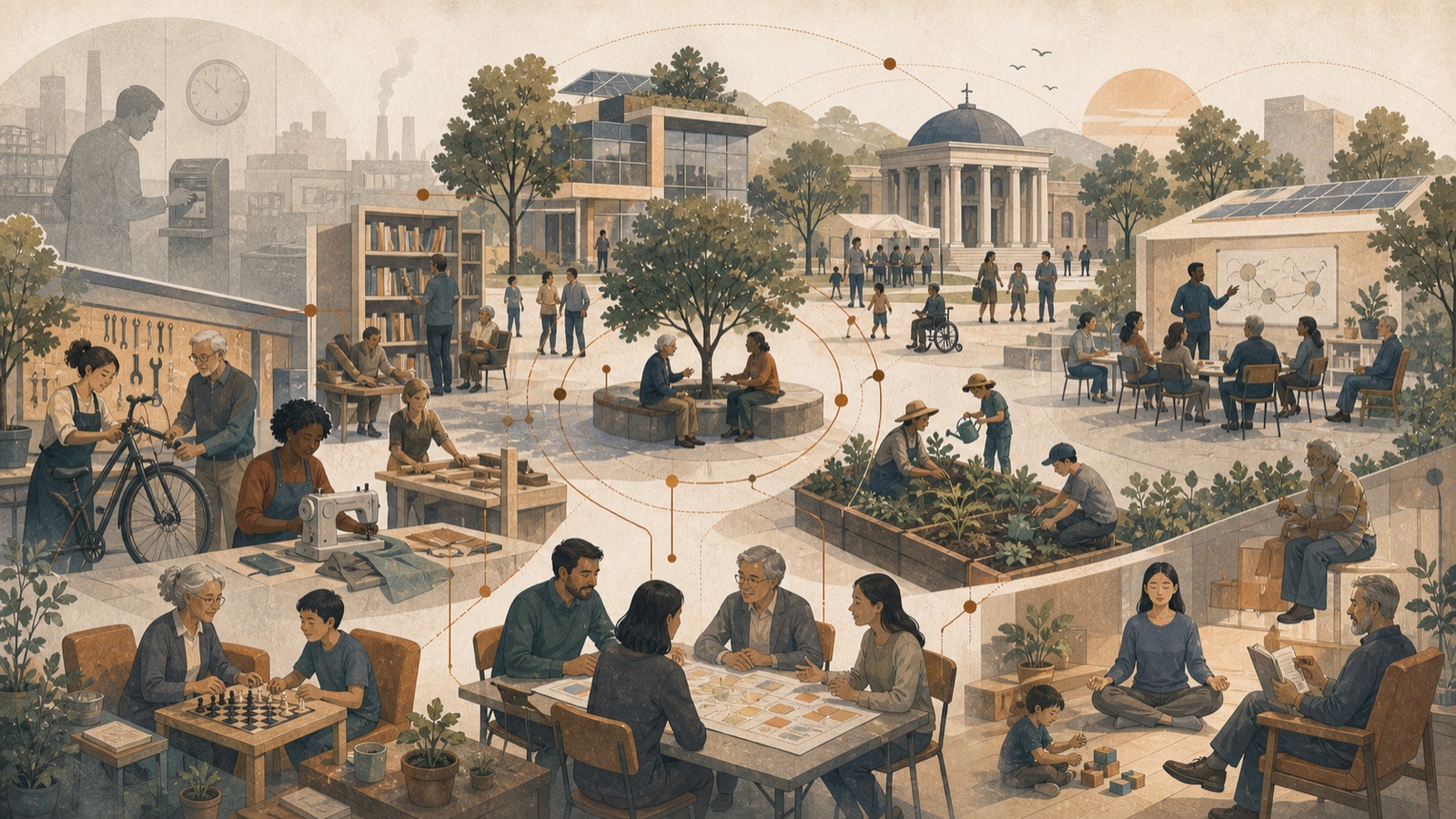
There is a question many prefer to postpone: if AI and automation gradually take over larger parts of both cognitive and physical labour, what happens then to people's everyday life, status and sense of meaning? The question is larger than employment. It goes directly into how we organise life, community and dignity.[1]
It is tempting to make the discussion either utopian or dystopian. Both reactions are too simple. A society with less necessary wage work can become freer and richer. But it can also become more fragmented and more meaningless if we do not build institutions that sustain life beyond work.
Work is more than income
Modern society has made work a central axis of identity. When we meet someone new we almost reflexively ask what the person does for work. Income, status, daily rhythm, social networks and self-image have become tightly bound to occupational role.
That means that a future with less wage work is not just an economic transition. It is also cultural and psychological. We need to replace not only the income from work, but also what work has long delivered: progression, recognition, discipline, belonging and the feeling of being needed.
Meaningful life without wage demands
People do not need wage work to find meaning. We find meaning in relationships, care, learning, creation, local community, civil society, research, sport, crafts, nature and civic responsibility. The problem today is often not a lack of meaningful activities, but a lack of time, security and social legitimacy to pursue them.
A society with less necessary wage work could therefore free up space for parenthood, care for older people, culture, public education, civil engagement and local responsibility. But that requires such work also to gain institutional value. Otherwise it risks becoming private consolation in the shadow of a society that still measures human worth primarily by wage.
The transition can be hard
It is important not to romanticise. When people lose work they often lose more than income. They lose rhythm, context, collegiality and public identity. Experiences from unemployment and deindustrialisation show that loss of meaning can be as harmful as loss of income.[2]
It is not enough to say that people just have to "find new interests". Society must offer new forms of status, participation and mastery. Otherwise technical liberation risks feeling like social erasure.
Which institutions can sustain life after work
Here the conversation needs to become more concrete. A sustainable society with less wage work requires not just money, but sustaining structures. I believe especially in five types of institutions:
1. Local learning centres and public education with high status. Places where people can deepen their knowledge, change course, contribute and develop competence without everything having to be justified by immediate financial return.
2. Strengthened culture and sports infrastructure. Not as recreational luxury, but as cohesive institutions where people can gain recognition, rhythm and community.
3. New forms of civic duty and public service. Roles where people can contribute in care, crisis preparedness, local community and knowledge-sharing even outside traditional employment.
4. Better support for care work. If technology frees up time it should become easier, not harder, to care for children, older people and others without falling into economic vulnerability.
5. Security systems that do not rest solely on wage work. The exact model may vary — basic services, social dividend, negative income tax or other solutions — but the point is the same: a strictly wage-centred contract becomes more strained when production to a greater degree is decoupled from human hours.[3]
What remains our responsibility
Whoever sees only threat in the AI shift misses the opportunity for a richer human life. Whoever sees only freedom misses how difficult the transition can be. Both things can be true at the same time.
The technology can free up time. It cannot by itself create meaning, justice or belonging. That work remains human, political and cultural. If we do not do that work in time we risk ending up with a society where machines produce more than ever, while people still feel more expendable than free.
Source notes
The sources below support especially the labour market section. The institutional proposals in the essay are explicitly normative.
- For broad labour market context, see WEF Future of Jobs 2025, ILO 2025 update and IMF.
- ILO's updated assessments of exposure to generative AI are in Working Paper 140; inequality and transition dimensions are also discussed at IMF.
- See IMF 2026 for productivity potential and PwC for how AI can change the relationship between work, productivity and value creation.