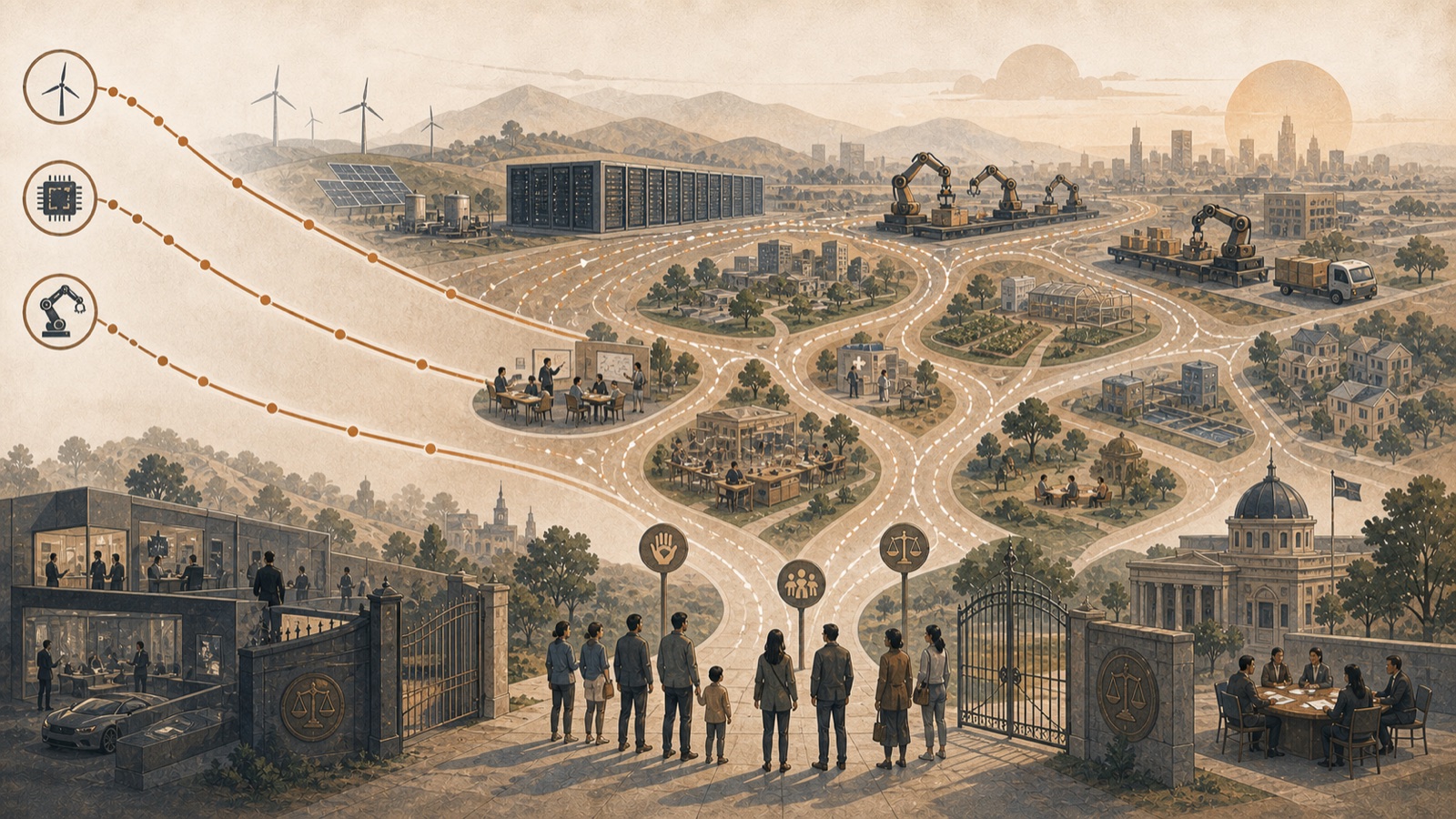
There is a recurring idea in many future discussions about AI, energy and automation: that certain costs can continue falling so rapidly that parts of the economy start behaving differently. That is an important idea. But it is often written about sloppily.
I believe we should talk about abundance as a direction, not as a promise. Not as "everything free", but as a development where marginal costs in certain domains are pressed so far down that old assumptions about price, supply and labour start becoming less stable.[1]
Three curves that matter
The first concerns energy. Renewable electricity and storage have pressed costs significantly, although grids, permits, financing, raw materials and system integration still set clear limits.[2]
The second concerns computation and AI. In certain use cases the model becomes better at the same time access becomes cheaper and easier to integrate into workflows. That lowers the cost of performing parts of cognitive work.
The third concerns automation. When better software, machine vision, robotics and planning are linked together, the need for human hours per unit produced can decrease in more sectors than before.
None of these curves reaches literal zero. But they do not need to for them to have large societal effects. It is enough that they fall far enough to change incentives, business models and power relations.
Why lower cost does not automatically bring justice
Here many arguments go wrong. Lower production costs do not in themselves lead to broad welfare. They can equally lead to value concentrating with those who own the models, infrastructure, energy, data and distribution channels.
That is why the discussion about abundance is not primarily a question of technology optimism or technology pessimism. It is a question of institutions. Who owns the capacity? How are the gains distributed? Which basic services are secured collectively? Which costs actually fall for households and which stay in intermediaries?
The valley between scarcity and greater capacity
Even if several cost curves continue downward, the transition is likely to be messy. Old jobs can be pressured before new security systems are in place. Some goods and services can become cheaper whilst housing, land, network capacity, raw materials and expertise remain scarce. It is therefore possible to have more technical production capacity without people immediately feeling more secure.
That is also why it is wise to write less about "the end of economics" and more about how the economy's centre of gravity can shift. In certain domains price pressure can become severe. In others scarcity remains tight. The societal picture will likely be uneven, not clean.
What can actually be said already now
We can say with reasonable confidence that faster cost falls in energy, computation and certain types of automation can provide greater material capacity. We can also say that a strictly wage-centred support system becomes more strained if production to a greater degree is decoupled from human hours.
What we cannot yet say with the same confidence is how quickly this occurs, which sectors are most affected first and how gains will be distributed. Therefore we should avoid both techno-utopian slogans and defensive denial.
Which questions should be central
The more serious question is therefore not whether "abundance" will automatically come. The serious question is how society should act if greater production capacity actually becomes possible whilst distribution becomes uneven.
Then five things come into focus: energy and grids, ownership of AI and automation infrastructure, access to data, forms for redistribution and expansion of basic services. If these questions are handled well, faster cost falls can become an actual societal gain. Handled poorly, the same technology can reinforce both inequality and mistrust.
Source notes
The essay describes abundance as a possible direction under certain conditions, not as a certain forecast.
- For broad technical and economic context, see Stanford AI Index 2025 and IMF remarks on AI and productivity 2026.
- Energy and battery curves: IEA: Batteries and Secure Energy Transitions, IEA battery commentary 2026, IRENA 2025 and IRENA cost report 2024/2025.